
Foundational Knowledge for Better Bible Reading and Study
Structure, authors, key people, and geography
If you missed Part 1 last week, we covered the purpose, outcomes, and framework for reading the Bible. Those are the things to know and understand before we even open our Bibles.
Now, we’ll look at Scripture from a 30,000 foot view and get a lay of the land before we zoom in on its specific contents. This week we’ll look at:
- The Structure of the Bible
- The Bible’s Human Authors
- Key People in Scripture
- Basic Geography of the Bible
Don’t feel overwhelmed! We’ll look at each of these briefly and practically so no matter where you open up your Bible you can feel confident that you know what’s going on.
1. The Structure of the Bible
The Bible is one book in two parts: Old and New Testament with 39 books in the Old and 27 books in the New. The Bible tells one story–but not in chronological order (we’ll look at the story of the Bible next week). The Bible is organized by genre (type of literature) and also by book size in some cases. This organization helps us interpret these books correctly (we don’t read poetry the same way we read historical books). Below you’ll find an overview of how the Bible is grouped. In the left hand column you’ll see the genre and the right column lists the books of the Bible in the order they appear. If you’re a visual person, open up to your Bible’s table of contents and draw boxes around these groups so you can start to remember them this way:
| Books of the Bible | |
|---|---|
| OLD TESTAMENT | |
| Historical | Genesis Exodus Leviticus Numbers Deuteronomy Joshua Judges Ruth 1-2 Samuel 1-2 Kings 1-2 Chronicles Ezra Nehemiah Esther |
| Poetry/Wisdom | Job Psalms Proverbs Ecclesiastes Song of Solomon |
| Prophetic | Isaiah Jeremiah Lamentations Ezekiel Daniel Hosea Joel Amos Obadiah Jonah Micah Nahum Habbakkuk Zephaniah Haggai Zechariah Malachi |
| NEW TESTAMENT | |
| Gospels | Matthew Mark Luke John |
| Historical | Acts |
| Letters from Paul (Pauline Epistles) | Romans 1-2 Corinthians Galatians Ephesians Philippians Colossians 1-2 Thessalonians 1-2 Timothy Titus Philemon |
| Letters from Other People (General Epistles) | Hebrews James 1-2 Peter 1-3 John Jude |
| Apocalyptic | Revelation |
2. The Human Authors:
The Bible was written by about 35-40 different men (from kings to farmers) who were used by God to communicate His Words (2 Tim 3:16-17). Below you will find a chart with the book of the Bible and its corresponding author. Some books do not have a known author or they were written anonymously. Don’t let this bother you. The original recipients knew who the authors were and these books were accepted by God’s people at various points in history. See my recommended reading list at the end of the post if you want to learn more about this.
As you look at the chart below, you will see that Moses, David, Solomon, Luke, John, and Paul wrote multiple books of the Bible. Learn about these men and you’ll gain a lot of insight into the Bible.
Here are some great articles about the authors of the Bible if you want to dive deeper into who these authors were:
Meet the Bible’s Human Authors-An Overview
Meet the Authors of the Old Testament
Meet the Authors of the New Testament
| Genre | Book of the Bible | Author |
| Historical | Genesis | Moses |
| Exodus | Moses | |
| Leviticus | Moses | |
| Numbers | Moses | |
| Deuteronomy | Moses | |
| Joshua | Prob. Joshua | |
| Judges | Prob. Samuel | |
| Ruth | Unknown | |
| 1-2 Samuel | Began by Samuel; finished by others | |
| 1-2 Kings | Maybe Jeremiah | |
| 1-2 Chronicles | Ezra | |
| Ezra | Ezra | |
| Nehemiah | Ezra | |
| Esther | Unknown; maybe Modecai | |
| Poetry/Wisdom | Job | Unknown |
| Psalms | David, Asaph, Moses, others | |
| Proverbs | Solomon | |
| Ecclesiastes | Solomon | |
| Song of Solomon | Solomon | |
| Prophetic | Isaiah | Isaiah |
| Jeremiah | Jeremiah | |
| Lamentations | Prob. Jeremiah | |
| Ezekiel | Ezekiel | |
| Daniel | Daniel | |
| Hosea | Hosea | |
| Joel | Joel | |
| Amos | Amos | |
| Obadiah | Obadiah | |
| Jonah | Prob. Jonah | |
| Micah | Micah | |
| Nahum | Nahum | |
| Habbakkuk | Habakkuk | |
| Zephaniah | Zephaniah | |
| Haggai | Haggai | |
| Zechariah | Zechariah | |
| Malachi | Malachi | |
| NEW TESTAMENT | ||
| Gospels | Matthew | Matthew |
| Mark | Mark | |
| Luke | Luke | |
| John | John | |
| Historical | Acts | Luke |
| Pauline Epistles–(in order by word count–longest to shortest letter) | Romans-Philemon | From Paul |
| General Epistles–(in order by word count–longest to shortest letter) | Hebrews | Unknown; maybe Paul, Barnabas, or Apollos |
| James | James, the half brother of Jesus | |
| 1-2 Peter | Apostle Peter | |
| 1-3 John | Apostle John | |
| Jude | Jude, the half-brother of Jesus | |
| Apocalyptic | Revelation | Apostle John |
3. Key People –Who’s Who?
There are a lot of people in the Bible–and their names are often strange and hard to pronounce. The Bible is, after all, from an ancient time. But don’t let that overwhelm you! You can learn the key people in the Bible first, which will anchor you to the story of the Bible. I really like how Max Anders identifies key people in the Bible in his book 30 Days to Understanding the Bible and connects them to their part of the story of the Bible.
Here’s a modification of his chart and key people as they appear (along with where their story is told):
| Book of the Bible | Key Person/People | Who They Were |
| Genesis | Adam | The first man |
| Genesis | Abraham | The first patriarch (key figure who received a covenant from God) |
| Exodus-Deuteronomy | Moses | The leader of the Exodus |
| Joshua | Joshua | The leader of Israel’s army into the Promised Land |
| Judges | Samson | Israel’s most famous judge |
| 1 Samuel-1 Kings | David | Israel’s most famous king |
| Daniel | Daniel | The most famous prophet during the Exile (Israel’s time outside of the Promised Land because of their sin) |
| Ezra | Ezra | Israel’s leader who brought them back from Exile |
| Gospels | Pharisees | The religious leaders who rose up during the “silent period” after the time of the prophets |
| Gospels | Jesus | The Promised Messiah |
| Gospels, Acts, and 1,2 Peter | Peter | The leader of the Twelve Apostles and leader of the early church |
| Acts and Pauline Epistles | Paul | The world’s greatest missionary and founder of many early churches |
4. Basic Geography
It is helpful to consult a map (or use your study Bible’s maps) when you are reading Scripture. Always try to visualize a map of Israel when you read. Know generally where the Sea of Galilee is (in the north) and where the Dead Sea is (in the south). The map below includes where the twelve tribes settled after their entrance into the Promised Land. Notice that Jerusalem and Bethlehem are close together and in the tribe of Judah to the west of the Dead Sea. My favorite atlas resource with maps for every part of Scripture is: The Satellite Bible Atlas.
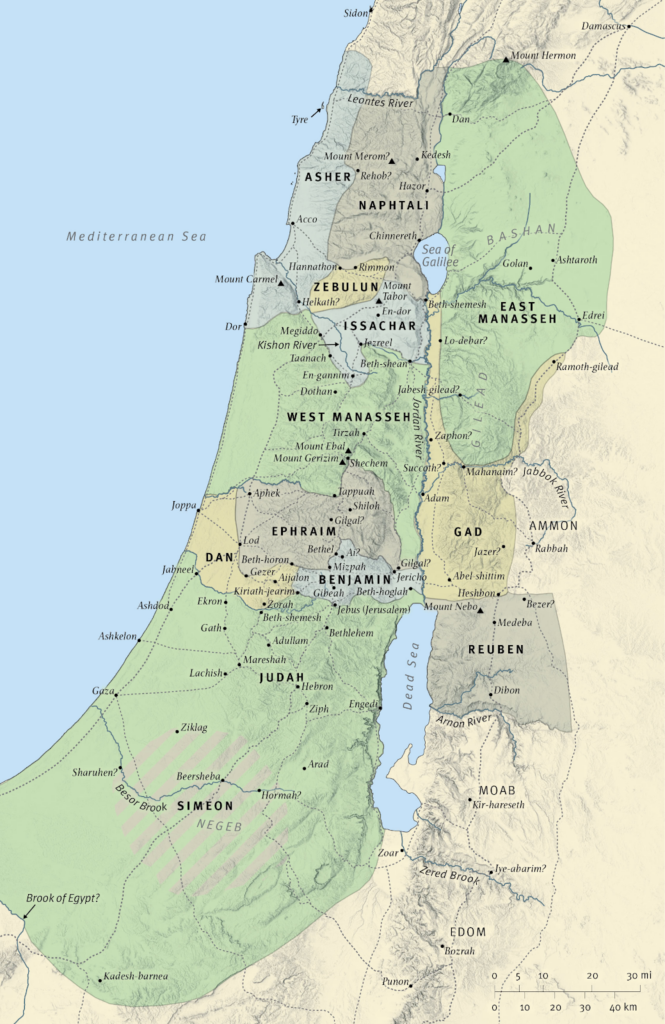
Map of Israel from ESV.org
Conclusion
I hope you see now that spending a bit of time orienting yourself to the Bible’s structure, authors, key people, and geography gives a tremendous amount of context and help for Bible reading and study. Keep these charts and maps close and refer to them the next time you open your Bible!
For further study:
A Visual Guide to the Bible: Seeing and Knowing God’s Word
30 Days to Understanding the Bible





0 Comments